Conversion in progress ...
Please wait while we generate your PDF
Financing Texas Land
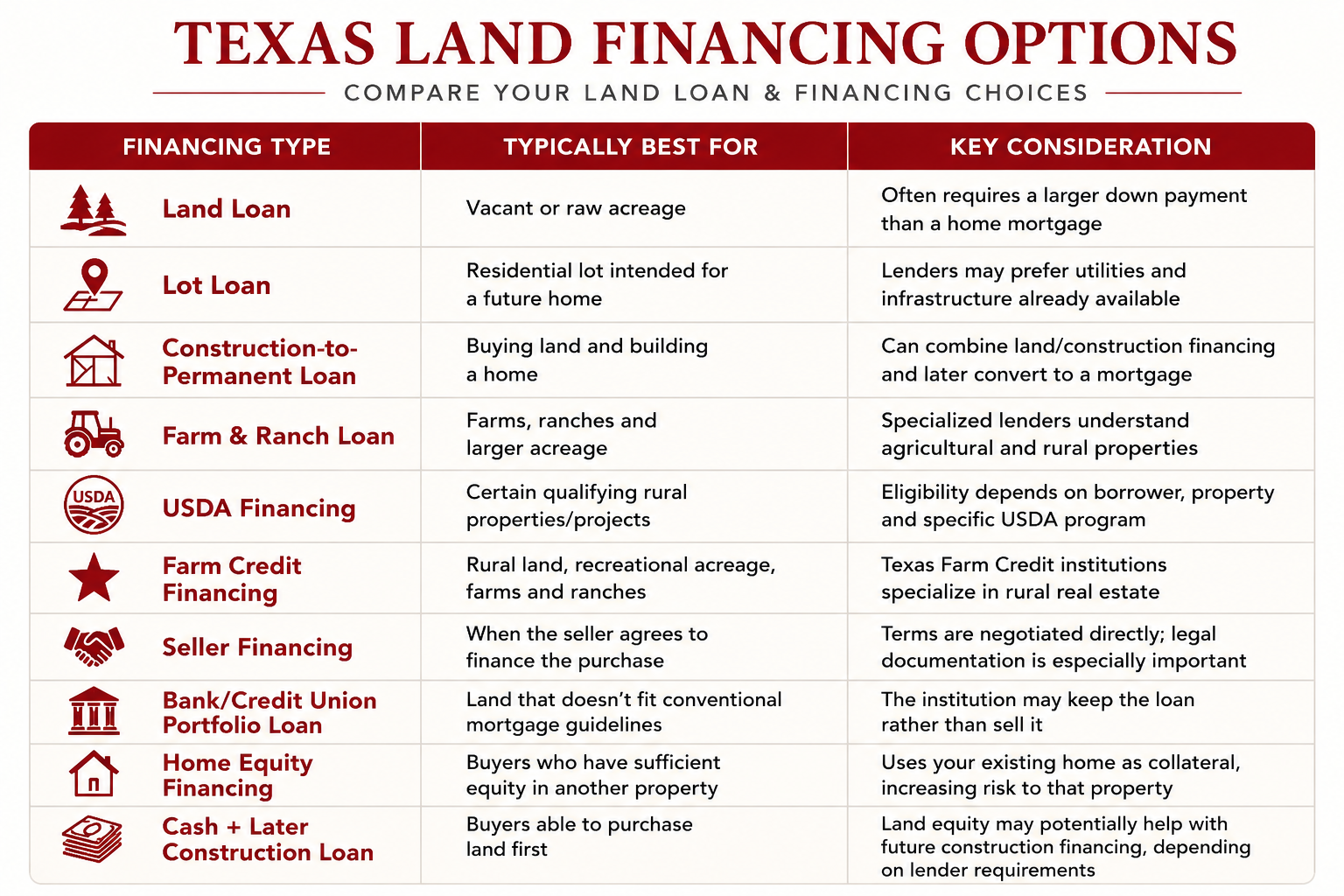
Three Categories Buyers Should Understand
1. Raw Land Loans
Land without utilities, roads or significant improvements can be harder to finance because lenders generally consider it higher risk. Buyers may encounter higher down-payment requirements, shorter terms or higher rates.
2. Improved Land/Lot Loans
Property with road access, utilities and other infrastructure may be easier to finance because it's closer to being development-ready.
3. Land + Construction Financing
If the buyer intends to build soon, a construction-to-permanent loan may make more sense than financing the land separately and obtaining another loan later.

Typical Texas Land Financing Criteria
There is no universal LTV for Texas land loans. Each lender sets its own underwriting standards based on the borrower, property, acreage, location, improvements, and intended use.
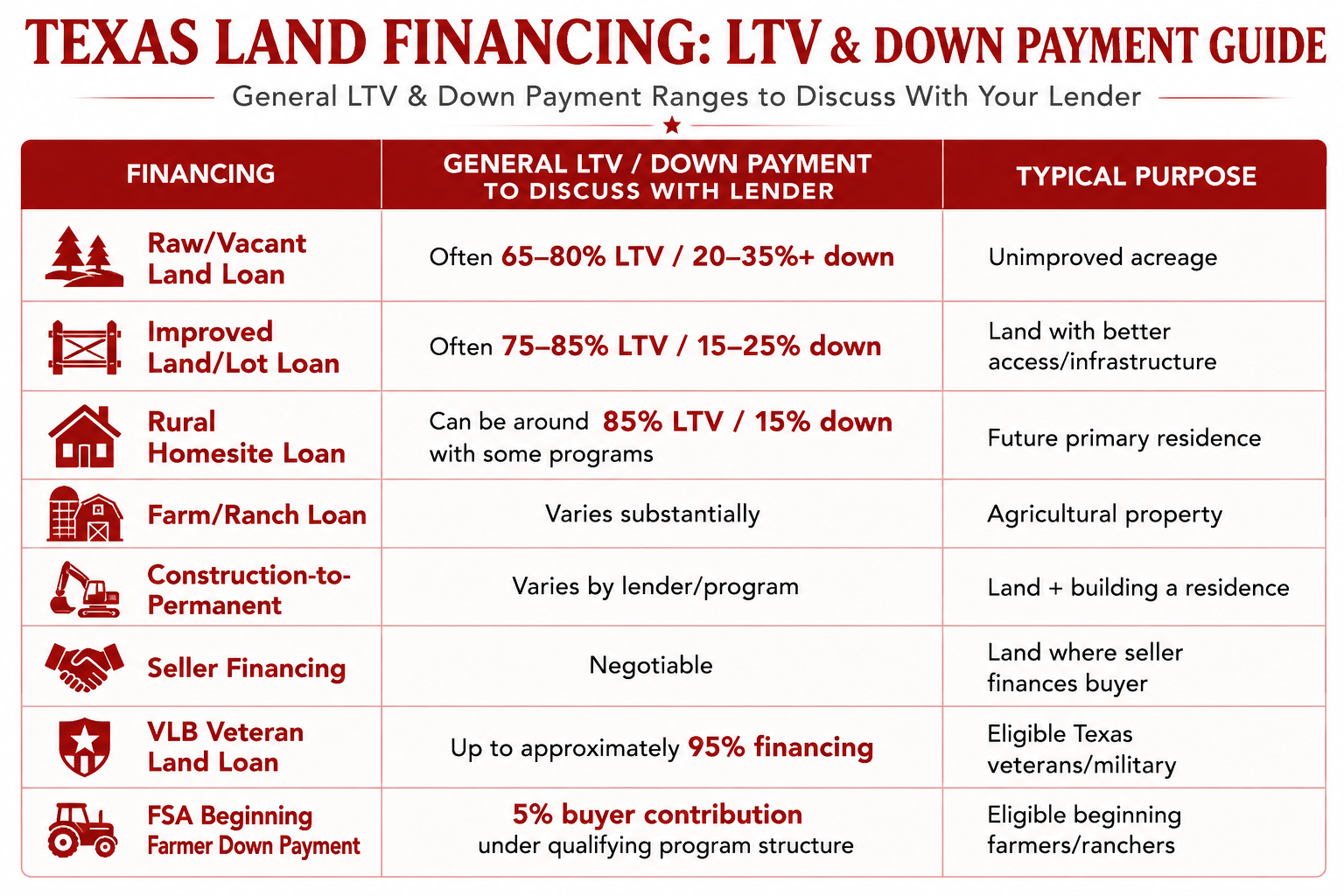
What determines your land-loan LTV?
Land lenders generally look at both the borrower and the property. Buyers should expect questions about credit history, income, debt obligations, liquidity/reserves, down payment, property value, acreage, legal access, intended use and available infrastructure.

Government & Special Land Programs in Texas
1. Texas Veterans Land Board — one of the strongest Texas-specific programs
The Texas Veterans Land Board (VLB) offers eligible Texas veterans and military members financing for qualifying Texas land.
The current program advertises a minimum 5% down payment, meaning up to roughly 95% financing, subject to credit approval. The program currently allows eligible individuals to borrow up to $200,000; qualifying spouses who are both eligible veterans may be able to borrow up to $275,000 together.
The property must meet specific requirements, including being entirely within Texas, generally containing at least one qualifying acre, and having legal and usable access to a public road.
Excellent option to investigate for:
Eligible Texas veterans and military members buying land.
2. USDA FSA Beginning Farmer & Rancher
This is very different from a USDA residential mortgage.
USDA's Farm Service Agency has programs designed to help eligible farmers and ranchers purchase farms and ranches. FSA specifically focuses part of its lending resources on beginning farmers and ranchers.
One particularly interesting option is the Direct Farm Ownership Down Payment Loan.
For qualifying beginning farmers/ranchers, the buyer contributes at least 5% of the purchase price. FSA can finance 45%, subject to the program maximum, with the remaining portion financed through another lender, cooperative, private party, or seller.
USDA FSA also offers direct, guaranteed and joint-financing Farm Ownership programs.
Best suited for:
People actually entering or operating a qualifying farm/ranch not someone simply purchasing recreational acreage.
3. USDA Rural Development potentially 100%, but there's an important distinction
USDA's Single Family Housing Guaranteed Loan Program can provide 100% financing for qualifying low- and moderate-income borrowers purchasing or building a primary residence in an eligible rural area.
But this should not be marketed as a general "zero-down vacant land loan."
It's a housing program. The borrower, property, location and intended residence must satisfy USDA requirements.
That distinction is very important for your website.
4. Texas Bootstrap Program
Texas also has the Texas Bootstrap Loan Program, but again, this isn't simply assistance for buying recreational vacant land.
It's a self-help housing program for qualifying lower-income households who contribute substantial labor toward building or rehabilitating their home. TDHCA currently states that the maximum Bootstrap loan is $45,000, at 0% interest for up to 30 years, and participating owner-builders generally must provide at least 65% of the labor. Availability is also limited geographically.

Land Financing Risk
Higher Down Payment: Land lenders may require significantly more cash upfront than a traditional home mortgage.
Higher Interest Rates: Vacant or raw land may be considered higher risk, which can result in higher interest rates.
Shorter Loan Terms: Some land loans have shorter repayment periods than a traditional 30-year mortgage.
Balloon Payments: Some loans require the remaining balance to be paid or refinanced after a certain number of years.
Variable Interest Rates: Some land loans have adjustable rates, which means your interest rate and payment could increase over time.
Refinancing Risk: Don’t assume you’ll automatically qualify to refinance when a balloon payment or construction deadline arrives.
Property Appraisal Risk: If the land appraises below the purchase price, you may need additional cash or have to renegotiate the transaction.
Development Costs: Wells, septic systems, electricity, roads, clearing, drainage, and site preparation can significantly increase the true cost of purchasing land.
Construction Financing Risk: If you plan to build later, lending requirements, interest rates, or your financial situation could change before you're ready to obtain construction financing.
Land Equity Assumptions: Don’t assume all the equity in your land will automatically count toward the down payment or equity requirement for a future construction loan.
Seller Financing Terms: Interest rates, balloon payments, default provisions, and other terms can vary significantly with seller financing. Have the documents professionally reviewed.
Existing Home as Collateral: Using home equity to purchase land puts your existing home at risk if you're unable to repay the debt.
Taxes & Carrying Costs: Property taxes, insurance, maintenance, fencing, and other expenses continue even when the land isn't generating income.
Agricultural Valuation Changes: Don’t assume the seller’s agricultural valuation will automatically continue after the purchase. Changes in eligibility can significantly affect future property taxes.
Liquidity Risk: Land may take longer to sell than a traditional home, which can make it more difficult to access your equity when you need it.
Overleveraging: Financing the land and then separately financing improvements and construction can leave buyers with more debt than anticipated.
Know the Loan Before You Buy the Land.
Yes, it’s a lot! but don’t let that overwhelm you! Understanding these risks now can save you from costly surprises later. And remember, you don’t have to navigate it alone we’re here to help you every step of the way.
Elite Realty Group a Redfin Premier Team